DIY Methods to Identify Mold
Simple at-home approaches, what they can tell you, and when a professional assessment is a better next step.
DIY checks can be a starting point for suspected surface mold. Use appropriate ventilation and safety precautions, and seek professional support for extensive growth or unresolved moisture.
How to do a DIY bleach test to identify mold
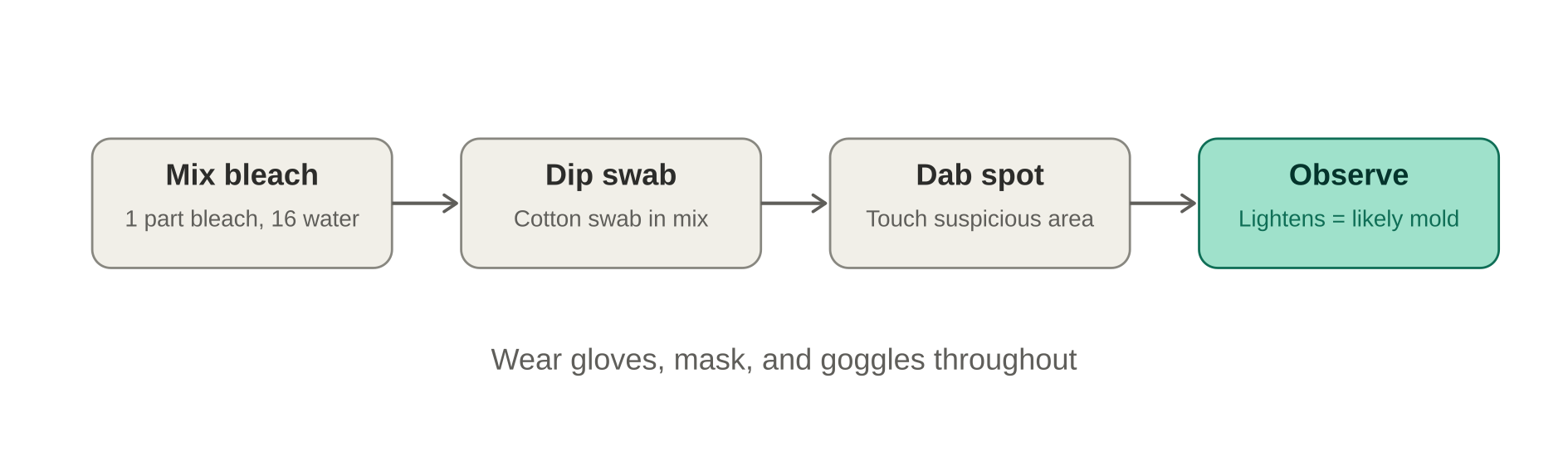
- Mix diluted bleach: Mix one part bleach with sixteen parts water.
- Dip a cotton swab: Dip a cotton swab into the diluted bleach mixture.
- Dab the suspicious spot: Dab the swab on the suspicious area you want to test.
- Observe the reaction: If the spot lightens within a couple of minutes, or keeps coming back after cleaning, it is likely mold rather than ordinary dirt.
Frequently asked questions
What household items can test for mold?
Diluted household bleach and a cotton swab can give a quick indication of mold versus dirt on a surface. Beyond that, dedicated DIY test kits with swabs, tape, or petri dishes are needed for more reliable results.
Does vinegar kill mold the same as bleach?
Vinegar can kill some types of surface mold and is gentler on porous materials than bleach, but it is not effective on every mold species and does not address the underlying moisture source. Bleach is more commonly used for testing and killing mold on hard, non-porous surfaces.
How accurate are at-home mold test kits?
Surface swab kits are reasonably reliable for confirming visible growth is mold. Air quality petri-dish kits are less precise since every home has a baseline level of airborne spores, so results need to be interpreted with context rather than as a definitive yes or no.
Can you test for mold with a phone camera or blacklight?
A blacklight can sometimes make certain mold types fluoresce, but it is not a reliable standalone method since many non-mold substances also fluoresce. A phone camera has no capability to detect mold and is only useful for documenting visible growth.
How much does a DIY mold test kit cost?
Basic culture plate kits start around $10, while more comprehensive kits like ERMI (Environmental Relative Moldiness Index) tests can run up to roughly $300. Even higher-end kits remain self-administered and do not replace a professional inspection for confirmed problems.
SOURCES
This article is for general information only. Follow product safety instructions and seek professional assistance for extensive mold or water damage.